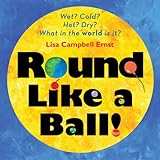
by Lisa Campbell Ernst
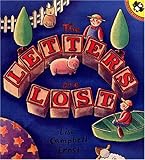

This book reminds me of my house. We are always looking for some lost game piece. My children could relate to this book when they were younger.... and come to think of it, they can still relate.
When I first found this book, I wondered, "Why didn't I think of that?" It is a simple theme and a common every day activity - losing parts of toys. So young children can easily relate to the book. Further it provides excellent opportunities to teach letters in a variety of ways. Check my suggestions at the end of this dialogue and please feel free to add ideas for others.
The wooden blocks arrived neatly packed in their box. Somehow they have gotten lost so the reader must try to locate them. The A is in an airplane, the B has tumbled into the bath, and the L has landed in a pile of leaves. Each block is easily identifiable for young children who are learning their letters. Children love to "look" for the letters and then see that they are back together---- but "not for long. Just like my house!
ACTIVITIES:
Procedure:
1. Hide the 26 alphabet blocks around the classroom or on the playground so the children can find them easily the first time. (As they become more adept at the game, hide them in more obscure places.
2. The 26 alphabet blocks are hiding in the classroom or on the playground.
3. The children must very quietly creep up on the lost letters so they won’t be frightened.
4. The first time, allow the children to find the letters that they are able to find.
5. When they find a letter, they are to return to the carpet circle so others can find a letter. They may be given the opportunity to talk with another child on the carpet circle about the letter.
6. After all of the letters are found, have the children name the letter and show it to the other children.
7. Ask the children to name the letters in alphabetical order while the child holding that block places it in a line.
Variations:
After playing the game described above, try these variations:
Variation 1:
1. Hide the 26 alphabet blocks again. It may be fun to find a different location such as the playground (on a nice day.)
2. Turn the 26 cards with the alphabet printed on it face down.
3. Allow each child to select a card and name the letter on the card. Help the children who do not recognize the letter name.
4. Allow each child to look at his card and find only that block. After finding the block, he should sit on the carpet and place the block and letter together.
5. Ask the children to name the letters in alphabetical order.
6. Ask the child with the card that has the letter A on it to stand. Have him name the letter and then place it on the floor.
7. The child with the letter B should name his card and then place it next to the A card and continue this procedure until all of the letters have been positioned.
8. Next, have each child name the letter with the block on it on top of the letter card. The block with the letter A on it will be placed on top of the letter card.
Variation 2:
1. Hide the 26 alphabet blocks again.
2. Allow each child to select a picture card, which correlates to a letter.
3. Ask each child to name the object on the picture.
4. Ask each child to identify the letter that the object begins with.
5. Allow the children to find the letter that corresponds to the letter the that the picture begins with as listed on the card.
Variation 3:
Follow the similar procedure above, but provide the child a card that has the missing letter. For example,
A_C. The child finds the letter that is missing. Then returns to the carpet circle.
Variation 4:
After discussing the letters, begin discussing the sound each letter makes. (A says /a/ like ant) Follow the same procedure for the sound of each letter.
Variation 5:
After collecting the letters place them in the center of the carpet circle. Play Marching Around the Alphabet by Hap Palmer so the children follow the lyrics’ directions.
Variation 6:
Have the children hide the letters near, under or beside an object that begins with the same letter. That child selects another child to find the letter by giving clues.
Variation 7:
The children can do an art activity.
Materials:
•glue stick
•magazine or old workbook to cut
•construction paper
Procedure:
1. Each child selects a letter to focus on.
2. The child draws a letter block on a sheet of paper. Then he draws an “environment” surrounding the drawn block.
3. Children can then cut a picture from a magazine (or drawn an object) that begins with the same letter.
4. Glue the picture on a small piece of paper.
5. Show the children the way to cut a tab around the object and cut the picture from the paper and then fold the tab.
6. Glue the tab to the paper by covering the block to hide it.
7. Children show their pictures then asks a class member to identify the hidden letter The picture on the tab will give the clue.
Other interesting books from this author are: