Thursday, October 22, 2009

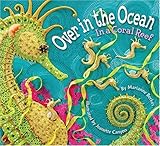
Over in the Ocean

Over in the Ocean
Marianne Berkes


Jeannette Canyon is simply a delight when it comes to making picture books come alive. The seahorses on the cover of Over in the Ocean: In a Coral Reef just seem to pop off the page. Each page presents the wow factor when seeing the sea creatures.

Books always present opportunities to learn and discover. But Marianne Berkes offers so many more opportunities than just the rhythm, words and beat of the rhymes. It offers adults a way to introduce and discuss numbers and quantities. Children search the animals out on each page and then the surprise at the end allows them to hunt for the objects before closing the book.

I knew Marianne must be a teacher when I saw the last few pages offering extended activities to enhance the book. Thanks, Marianne for adding the additional pages of activities. Parents and teachers will make good use of your suggestions.

When I was a child, we never discussed the author. She was someone who was not really that important. Thank goodness times have changed. Author studies are a significant study in preschools and throughout every child schooling. Studying authors provide valuable information for children and make books seem more realistic. I liked the way Jeannette added a photo of her office. It gave me a feeling of peeking behind the scenes and knowing her just a little bit better.

The back of the book provides adults with some valuable information to present to the children. The song, Over the Ocean” provides children an opportunity to become more involved through music – just what great preschool and primary teachers always do! The added information describing each sea creature is inspiring and fascinating.


ACTIVITY:
After reading the book, I would get the play dough ready for some inspiring children who will want to make a favorite ocean creature. Jeannette provides a wonderful explanation of her work with polymer clay. I would love to see children experiment with the medium.

This book also provides an excellent opportunity to use flannel board figures when discussing numbers and quantities.

City Beats: A Hip-Hoppy Pigeon Poem

City Beats: A Hip-Hoppy Pigeon Poem
by S. Kelly Rammel


The cover of this book immediately captured my attention. The time-consuming illustrations by Jeannette Canyon were made of polymer clay, which provides children with a somewhat realistic impression of birds in the city. Studying the illustrations is just as much fun as reading the book. There are window cut outs only add to the interest of the book. Children play peek-a-boo through the window before the pages are turned to reveal the true behind the scenes drama.

S. Kelly Rammel has provided us with a glimpse of a tiny microcosm of life in the city. The poem takes the pigeons from the early morning light to the end of the day. The words pop out on the page with the eye catching shadowed font. The poem gives a lasting impression of the life of a pigeon in the big city.

The introduction to the book offered us some interesting facts about pigeons. It is always beneficial to teach children important background information before beginning a subject.

ACTIVITY:
Study each page behind the window to get clues about life in the city. Children will use their figure ground skills to find hidden objects. Discuss each page in terms of how the city life is similar and different from the children’s.

Children can cut pictures from magazines and glue them on a sheet of paper. They can draw birds on the picture. Then children can then cut the shape of a window from another sheet of paper. Print a question or statement on the bottom of the page providing a clue as to what is hidden behind the window. Staple the sides together to make a book.

The book also lends itself to having children become actively involved through movements. For example:
Honk! (Children can mime honking a horn by pushing with their hand on a make believe horn.)
Squeak!(Children can put their first two fingers together with their thumb making a mouse that squeaks.
Find other parts of the book that promote movements.

Friday, October 16, 2009

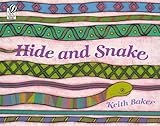
Hide and Snake

Children are fascinated by snakes and they also love play hide and seek games. So we have a winning combination in

by Keith Baker.

Keith Baker has created a charming rhyming book about a not so charming animal – a snake. This rainbow-colored snake playfully slithers through a colorful array of hiding places. The little book provides children with an entertaining experience of finding the hidden snake on each page. The decorative surroundings make finding the rainbow-striped snake more difficult to follow. The hunting gives children practice in figure ground perception – a very important pre-reading skill - by finding the snake in the multichromatic environment.

ACTIVITY:
Children like talking about the movements the snake makes on each page. "What movement did he make on the page where he was hidden in the yarn.” Ask children to “slither “around places in the room or playground. Encourage them to use verbs like the ones used in the book. “I am looping through...., I am curling around...and think of the verbs used in the book.

With children who are beginning to read, make a list of the ‘movement words’ that helps tell the story. Tell them a collection of words used primarily to indicate types of action are called verbs. Think of other action words and make the movements of those words.

Another activity might be drawing or painting a picture while hiding a snake in the environment. Have the children write a sentence about the snake at the bottom of the art.

Friday, October 2, 2009

S is for Story: A Writer's Alphabet

It was love at first sight when I saw this book. I just couldn’t wait to open it. And, I wasn’t disappointed. From the little aviator on the cover to the Post Script, it is jammed with information for beginning writers.

This book is invaluable for all children and should become a basic test in every elementary classroom library. It inspires beginning writers to learn the important elements involved in becoming a writer. Each topic is thoroughly explained in simple terms for children.

Each beautifully illustrated page highlights a letter. Each letter page further offers a pertinent verse, which highlights an element of good story writing. The book explains the origins of writing tales and the progression of writing those tales. The history integrated into the letter A is a great beginning. Every subsequent letter highlights an important element involved in writing. Certainly the author has thought of everything.

The author immediately commands the respect of elementary school teachers. I knew she must also be a teacher. Esther Hershenhorn teaches Writing for Children at the University of Chicago’s Writing Studio. She has also written several additional books that can be seen at the bottom of this page. If they are anything like S is for Story, they are “must buys.”

Zachary Pullen’s illustrations are simply captivating. The intricacies of each page are a study in writing without the text. Finding only one page to highlight would be difficult because all of the illustrations are so wonderful.

This is a must have book!


ACTIVITY SUGGESTION:

The letter Q sparked my creativity. Wouldn't it be fun to have T shirts with the questions (who, what, where, when, why) printed on them. Each child wears a shirt for a few days. Each decides on a topic. They write answers to the questions in their journals. They then use the journals as a reference when writing about the selected topic.

The Value of Children's Books

1. provides a pleasurable experience
2. develops visualization and imagination
3. aids in finding meaning
4. provides time to reflect on personal experiences
5. provides opportunities for additional clarification through rereading and discussion
6. assists in the development of processes and skills
7. allows for focusing on predicting, concluding and problem solving
8. develops a sense of curiosity
9. builds a foundation for learning to read and continued reading
10. enhances life’s experiences
11. strengthens listening skills
12. encourages an appreciation for the writings and drawings of others